Unconventional Computing with Internet of Bio-Nano Things on a Chip
Funded by TUBITAK 2247-D National Young Leaders Program Duration: June 2025 – June 2028
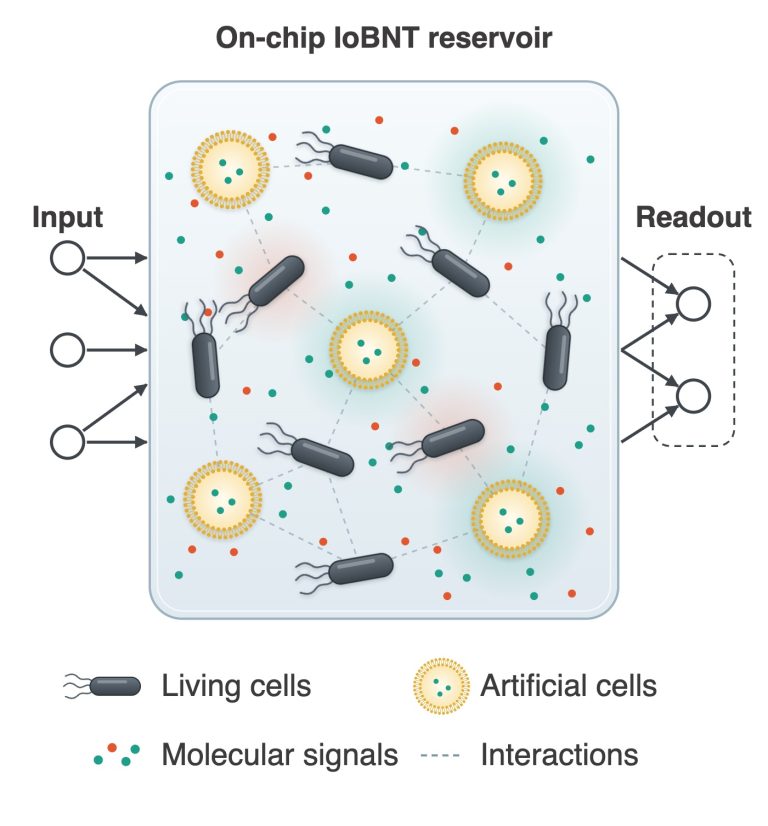
The Internet of Bio-Nano Things (IoBNT) is an emerging framework for networks of natural and human-made micro/nanoscale systems that exchange information through molecular patterns. Despite its promise for healthcare and agriculture, IoBNT research has so far remained largely theoretical. This project will develop the first microfluidic on-chip IoBNT platform, where living cells and liposome-based artificial cells interact via molecular communications in a controlled microenvironment. Using physical reservoir computing, the platform will then be turned into an unconventional computing substrate for biochemical (wetware) artificial intelligence. The outcomes will also support the quantitative design of microphysiological systems, such as organ-on-chips and organoids.
Project ARMOC
Adaptive and Reconfigurable Receiver Architectures for Molecular Communications towards Internet of Bio-Nano Things
Funded by TUBITAK 1001 – #123E516 Duration: March 2024 – March 2027
Recent advances in synthetic biology allow the replication of receptor regulation mechanisms in synthetic cells. Coupled with the parallel developments in dynamic bio-interfaces with tunable ligand-receptor interactions, there are now opportunities to incorporate hardware-based adaptivity to MC receivers in both biotic and abiotic realms. The objective of this project is to harness these opportunities by developing adaptive and dynamically reconfigurable biosynthetic and biosensor-based receiver architectures that leverage the tunability of ligand-receptor interactions to maintain high detection performance under time-varying MC scenarios.
Synthesis and Functionalization of Giant Vesicles towards Molecular Communications with Artificial Cells
Funded by Koç University Seed Research Program Duration: July 2024 – July 2025
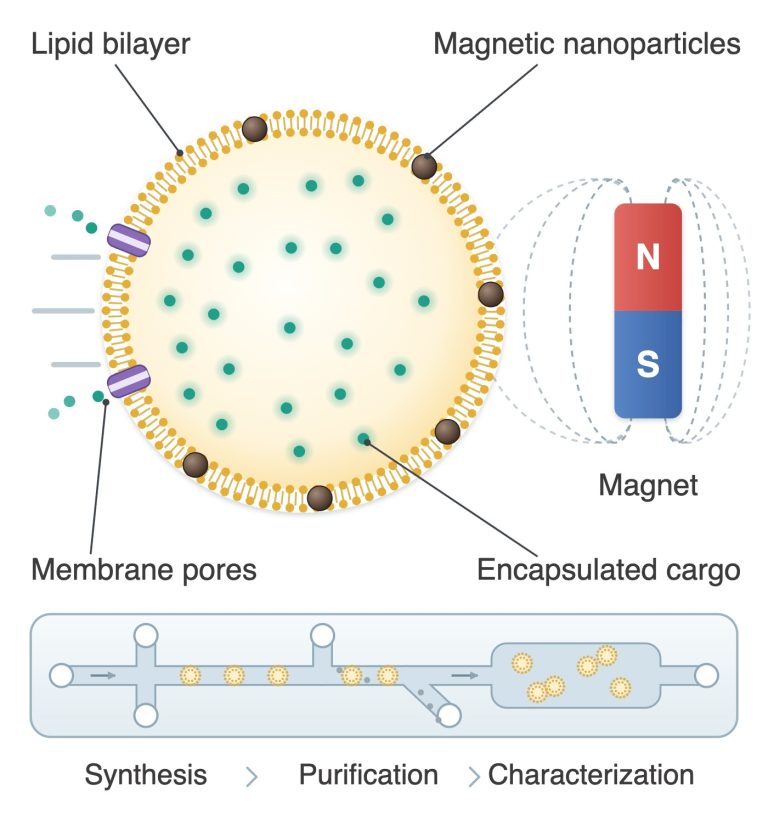
Giant unilamellar vesicles (GUVs) are cell-sized lipid compartments with membranes similar to those of natural cells, which makes them a widely used model for bottom-up artificial cells. The objective of this project is to develop an integrated microfluidic chip for the synthesis, functionalization, purification, and characterization of GUVs, and to validate it through proof-of-concept demonstrations of magnetic locomotion and chemical release. The project is the first step towards an on-chip Internet of Bio-Nano Things platform, where artificial cells interact with living cells via molecular communications.
Project MIMOGRAPH [completed]
Microfluidic Molecular Communications with Graphene-based Two-dimensional Nanoscale Receivers for Internet of Nano Things
Funded by TUBITAK 1001 – #120E301 Duration: June 2021 – December 2024
The main objective of this project is to develop the first micro/nanoscale experimental test and validation platform for microfluidic molecular communication (MC) systems accompanied by a theoretical design, modeling and optimization framework, and to devise novel experimentally-validated low-complexity MC methods, such as modulation, coding, synchronization, and detection techniques.
Engineering Ligand-Receptor Interactions for Molecular Communications
Funded by Marie Skłodowska-Curie Actions | Individual Fellowship Duration: December 2021 – December 2023
Ligand-receptor (LR) interactions are essential for artificial molecular communication (MC) systems to have a selective and reliable channel/receiver interface in the form of a biorecognition layer consisting of ligand receptors. Recent studies have revealed the dramatic impact of LR interactions on the overall MC performance in terms of channel bandwidth, molecular interference, receiver sensitivity and dynamic range, posing a multi-objective optimisation problem. The aim of REINFORMATION is to understand, optimise and engineer the LR interactions for high data-rate and reliable MC systems.